4 Simplifying QM for Faculty
Why Simplifying QM Matters for Faculty
After using QM for my own course development and completing several peer reviews across higher education, I began thinking about how to bring what I learned back to my own institution. As part of working on my career goals this year, I wanted to take the knowledge and experience I gained and turn it into something practical and helpful for the faculty I support.
In the college sector, we face real challenges with workload, limited staffing, and tight schedules. Many faculty have heavy teaching responsibilities, and with the lack of SWF for course development, asking them to complete the full QM training is not realistic. Funding and resources are also limited, so not every instructor can spend the time needed to learn the entire QM Rubric or understand all 44 Specific Review Standards. I realized that if I wanted faculty to benefit from QM principles, I needed to simplify them in a way that fits their reality.
Adapting QM Standards for Real Teaching Environments
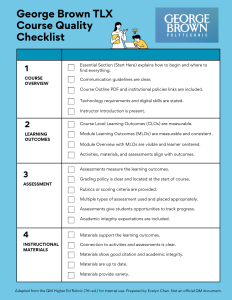
This led me to adapt QM Standards for busy instructors and create the George Brown TLX Course Quality Checklist, which gives faculty a first step into understanding what QM is about. In the beginning, I tried to adapt the rubric into a simplified version, but as I continued working on it, I realized the rubric should come later. Faculty need to understand the basic concepts of QM first before they can make sense of a simplified rubric. A checklist is easier to use, faster to adapt, and more approachable for those who are just getting started. The details of QM and the annotations are important, but without understanding the overall purpose, misinterpreting them will not help the process. A checklist allows faculty to begin right away, and it follows the idea of starting small.
Designing a Checklist That Is Practical and Easy to Use
I designed the checklist to be more visual and engaging, so it does not look like a long text-heavy document or a complicated list. The goal was to make it inviting, simple, and easy to use at a glance. Many faculty prefer tools they can scan quickly, so using icons, colour sections, and short phrases makes the checklist more approachable. This visual approach also reduces cognitive load and helps faculty focus on one part of the course design at a time.
Organizing the Checklist Around the Course Design Workflow
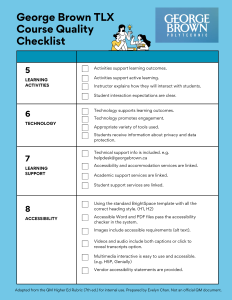
I organized the checklist around the 8 General Standards, but in a sequence that matches the natural process of building a course. Faculty usually begin with the course overview, define their learning outcomes, and then design assessments. Once these are clear and aligned, instructors can choose instructional materials and plan learning activities that support the outcomes.
The checklist also includes the institutional template and recommends having the first item in BrightSpace labeled as the Essentials Section (Start Here). This section contains important information such as the faculty bio, the Course Outline (PDF), which is our institution’s naming convention for the course syllabus, academic services, tech support, AI usage guidelines, and other key resources. Communication guidelines, such as expectations for respectful language and professional interaction throughout the course, are also included in the Essentials Section.
Prioritizing Support and Accessibility Without Overwhelming Faculty
Items related to learner support and accessibility are placed near the end of the checklist, not because they are less important, but because most faculty rely on TLX for help in these areas. Keeping these last makes the process feel achievable, knowing support is available when they need it.
Reducing the 44 Standards to 38 Simple Checklist Items
While QM includes 44 Specific Review Standards, the simplified checklist reduces these to 38 items with clearer, more straightforward wording. Each General Standard has only four to six items to check off. The intention is not to replace QM or remove its depth, but to give faculty an entry point that does not require reading annotations or completing formal training. The simplified wording helps faculty understand the expectations without feeling overwhelmed. It also helps build their awareness of alignment, clarity, and accessibility in a practical and meaningful way.
Creating Quick-Start Guides and Tools for Busy Instructors
Busy instructors often benefit most from tools they can use immediately. Quick-start guides and checklists break down complex processes into small, achievable steps. The George Brown TLX Course Quality Checklist follows this approach by giving faculty a clear starting point, reducing cognitive load, and helping them focus on essential decisions. Rather than guessing what to include or how to structure a course, instructors can follow the checklist one step at a time.
Presenting the George Brown TLX Course Quality Checklist
The checklist can be presented in a simplified version with only the most essential items. This version is ideal for first-time users or for faculty who have limited time. There will also be an additional version for internal use. When faculty reach out to TLX for course support, we will include a rubric-style format. This version will use three levels: Not Present, Partially Present, and Pass, along with recommendations. The purpose of this version is to help faculty assess their progress more clearly and to help TLX identify where improvements are needed so we can support them in preparing a course for review or consultation.
How Faculty Can Use the Checklist in Practice
Faculty can use the checklist at many different stages of the course design process. These include planning a new course, building modules, revising existing content, or preparing a course for review. The checklist also works well during consultations with TLX, since it provides a shared reference and keeps discussions focused.
Connecting the Checklist Back to QM Principles
The George Brown TLX Course Quality Checklist is rooted in the key principles of QM. It emphasizes the Essential Standards, alignment between objectives, activities, and assessments, clear structure and instructions, and accessibility for all learners. By focusing on these areas, faculty can begin improving their courses even without formal QM training. Over time, the checklist helps instructors build confidence and familiarity with QM expectations and quality course design.
Media Attributions
- George Brown TLX Course Quality Checklist – Page 1.
- George Brown TLX Course Quality Checklist – Page 2.