The IntegrityMatters App
The IntegrityMatters App, with its digital badge utilized as a learner motivator and to evidence accomplishments (Foli, Karagory, & Kirby, 2016), is ideally positioned to become an integral part of a more comprehensive approach to academic integrity skill development that could be comprised of successive levels and applications to various workplace frameworks, each represented by the awarding of digital badges. In addition, consideration could be given to combining the IntegrityMatters badge with certification in other competencies that are similarly aligned and consistent with industry specific demands.
CanCred Factory Open Badging Structure
CanCred Factory Open Badges infrastructure is one example of an online, open standard that recognizes and verifies informal and lifelong learning. Launched with protocols and an over-arching framework for digital badges by the Mozilla Foundation (2011), with funding from the MacArthur Foundation, it is now led by IMS Global Learning Consortium and being adopted by an increasing number of educational institutions. CanCred Factory is a cloud-based management system that provides a centralized and simplified quality framework for open badges. It provides a comprehensive set of tools for creating, issuing and managing digital badges.
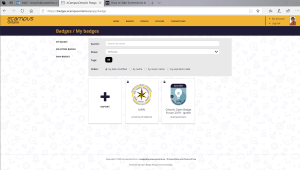
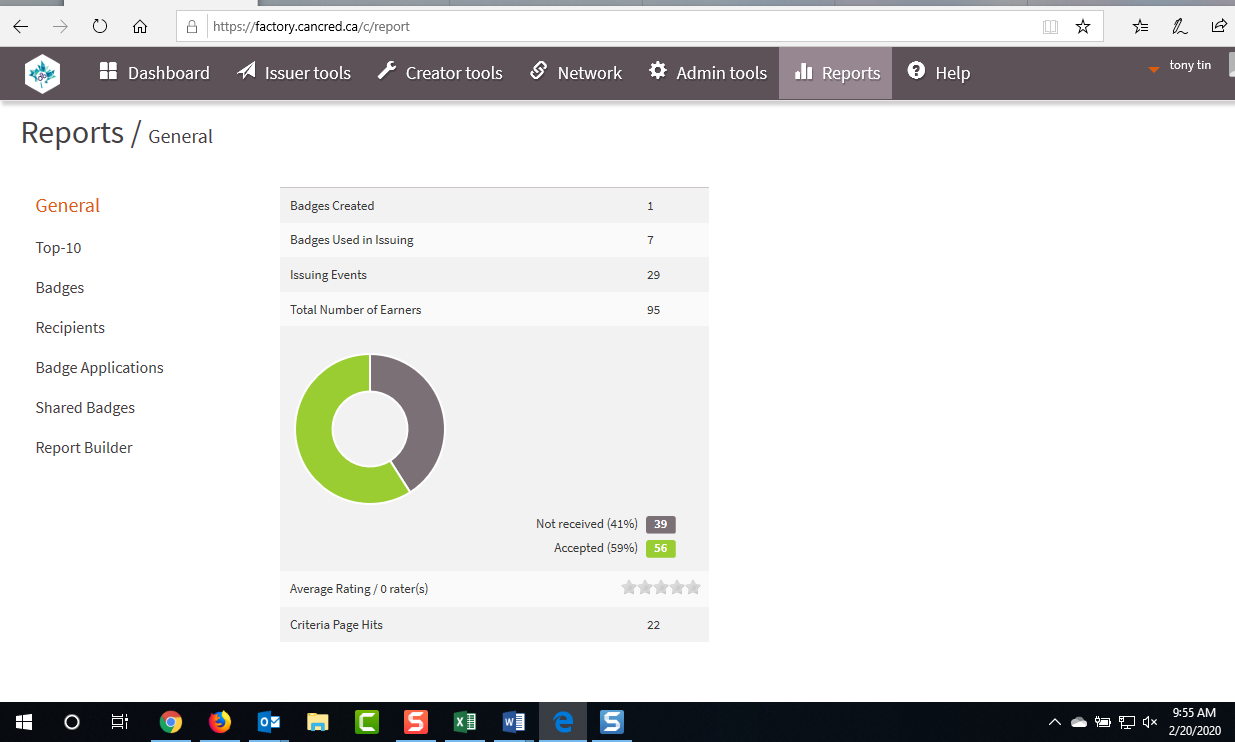
CanCred Passport is the default destination for open badges issued from its companion platform, CanCred Factory. The platform was developed by Discendum, a leading educational technology company in Finland. An extensive reporting system monitors how badges are being used and shared (See Figure 1). Some useful features that support the use of digital badges for project use include: badge applications, multilingual badges, evidence uploads to Open Badge Factory (OBF) server, user role management (administrator, creator, issuer), simple badge creation and issuing interface, integration with LMS, endorsements and open API for third-party plugins. A free online service is available where learners earn digital badges and can easily receive, store and share them at the Passport site (See Figure 2). Criteria within each badge specifically identifies proof of achievements and skills that enable linkages to the issuer and relevant credentialing bodies (how and when the badge is earned) with verifying evidence (linking to a description and documents that demonstrate the completed work).
The CanCred open badges infrastructure has multiple technical advantages over other badging systems. First, CanCred Factory and Passport enables and easily manages badges and sharing in an interoperable digital environment, avoiding the complexity of handling different management systems. Second, the infrastructure facilitates trusted brand recognition. The authenticity of the issuer organizations and achievement can be verified and authenticated via embedded web links and metadata. Third, the system supports evidence-based research, thus allowing user tracking and data analysis. Detailed reports can be generated, providing information for how badges have been received, used, and ranked by different target groups. Fourth, CanCred supports different open sources plug-ins and could be interoperable for easy integration with multiple Learning Management System (LMS), such as Moodle, WordPress, Mahara, Optima. Fifth, CanCred is mobile friendly and is fully functional with most smartphones and tablets for badge management and sharing. Finally, it easily engages and motivates badge earners, providing free personal learning cloud service where badge earners can display and share their badges and use them to build their ePortfolios. CanCred facilitates community building; allowing online social interaction between badge earners, organizations and communities of practice. Setting up a free a CanCred Passport account associated with the learner’s academic institution email address makes it possible to publish selected badges on learner’s profile pages via CanCred. Learners choose whether or not to claim badges earned. Additionally, learners may choose to make their badges viewable publicly.
IntegrityMatters Open Badging Project
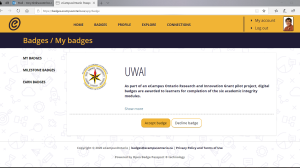
The vision of our digital badging evaluation project aimed to explore the best strategies, from a student user perspective, for accessing and understanding learner interest in using digital badges. The academic IntegrityMatters digital badge was awarded for successful completion of all the IntegrityMatters six modules. Our mobile academic IntegrityMatters project implemented a successful open badges strategy together with eCampusOntario, a non-profit corporation funded by the Government of Ontario, Canada (See Figure 3) and CanCred Factory (https://factory.cancred.ca). The mandate of eCampusOntario is to promote excellence in online and technology-enabled learning for all publicly-funded colleges and universities in Ontario (https://ecampusontario.ca). For our Canadian open badging project, the eCampusOntario Open Badge Passport site (https://badges.ecampusontario.ca), a dedicated instance of the same open source platform as CanCred Passport, but owned by eCampusOntario, was designed to be a recognition hub for Ontario post-secondary education and beyond. As part of an eCampus Ontario Research and Innovation Grant pilot project, the project team was provided with CanCred Factory accounts that issued badges, using the CanCred Passport Platform based on open source Salava code. Digital badges were awarded to learners for completion of the six academic integrity modules (See Figure 4). When a badge was earned, badge earners claim the earned badge at the eCampusOntario Open Badge Passport site (https://badges.ecampusontario.ca). This research blueprint provided the project team with hands-on experience in designing and using open badges for mobile academic integrity training in higher education.