Learning Objectives
- The Evolution of Podcasting
- Industry Voices & Visionaries
- The Wide-World of Podcasts in Education
Podcasting didn’t appear fully formed—it was built piece by piece by technologists, journalists, storytellers, educators, and creative risk-takers. Some became household names, while others worked behind the scenes, but all laid the foundation for a medium that now reaches hundreds of millions of listeners.
This chapter spotlights the first-generation innovators who helped define podcasting, including the researchers and educators who quickly saw its power for teaching, scholarship, inclusion, and community—and whose work often predicted where the industry was headed.
The term podcast blends “pod,” from Apple’s iPod, with “broadcast.” It entered the mainstream in 2005 when the Oxford Dictionary named it “Word of the Year,” crediting journalist Ben Hammersley with coining the phrase.
Early podcasts were largely extensions of traditional radio. Public radio organizations such as NPR sought new ways to distribute audio programs online. Initially, a podcast was defined as downloadable audio files automatically delivered to subscribers’ devices.
Today, that definition is more fluid. Audiences encounter podcasts on YouTube, Instagram, TikTok, Facebook, and across countless apps. Purists argue that a podcast must be downloadable audio, while others see it as an on-demand storytelling format—audio or video—untethered from any single platform
Podcasting’s roots trace back more than two decades. By 2004, three figures—an MTV veteran, a pioneering software engineer, and a journalist—had set the stage for what would become a global medium.
In 2001, media personality Adam Curry floated an idea on his blog that would spark the creation of the first podcast feed. Journalist and podcast historian Eric Nuzum has since chronicled that moment and preserved Curry’s original post. Curry had met in a New York hotel room with software innovator Dave Winer, whose work on blogging and RSS revolutionized online publishing.
After the meeting, Winer wrote: “Adam wants the Internet to be Everyman’s broadcast medium… to route around TV and radio networks, with no compromise in quality.” Winer soon modified RSS to allow audio enclosures—a breakthrough that made podcast distribution possible.
Two years later, Winer teamed with journalist Christopher Lydon to produce what is widely considered the first true podcast. Their show eventually became Open Source, now the longest-running podcast in the world.
Podcasting’s watershed moment arrived in 2014 with the debut of Serial. The investigative, serialized narrative shattered listening records—now surpassing 300 million downloads—and became the first podcast to win a Peabody Award.
Hosted by Sarah Koenig, Serial revisited the 1999 murder of a Baltimore teenager and the conviction of her ex-boyfriend, Adnan Syed. Courts cited the podcast in legal proceedings, and the case underwent multiple twists over the next decade. In 2025, a Baltimore court ruled Syed would not return to prison and reduced his sentence to time served.

Serial ignited the “Serial effect,” fueling mass-market interest in narrative nonfiction, especially true crime. Vox provides a retrospective on the role of Serial in the genre boom.
To mark the 20th anniversary of podcasting, Apple Podcasts released a list of what it considers the 20 most influential shows. The selections reflect podcasting’s breadth—from Serial to Call Her Daddy, Las Culturistas, Huberman Lab, and others that helped define new creative and commercial possibilities.
Podcasting’s early years are chronicled in the documentary Age of Audio, described by one reviewer as “a podcast meets documentary—really creative,” highlighting how the medium continues to reinvent itself.
Measuring innovation in podcasting is complex. The industry grew quickly and spans multiple sectors—journalism, entertainment, technology, education, and business. Audience metrics and revenue are often opaque and influence can be creative, cultural, political, financial, or technical.
Here is a limited list of the leaders who have left a lasting imprint on the medium – with roles as hosts, producers, sound designers, entrepreneurs, and media executives.
Radiolab popularized long-form, story-driven podcasts and influenced a generation of audio storytellers. As both a public-radio program and a podcast, the show presented complex scientific and philosophical ideas through a mix of investigative reporting, conversational explanation, and innovative sound design.
Co-founder Jad Abumrad’s experimental audio style—layering voices, soundbeds, and silence—became widely imitated. Robert Krulwich’s plain-spoken interviewing and willingness to interrupt experts for clarification helped make challenging topics accessible without oversimplifying them.
Radiolab’s influence is evident in later narrative shows, including Invisibilia, Freakonomics Radio, and Stuff You Should Know. Its impact is comparable to foundational programs such as This American Life and, later, Serial.
Ashley Flowers is the creator of Crime Junkie, one of the most consistently top-ranked podcasts in the United States, drawing an estimated 20 million weekly listeners and cultivating a large, loyal, and predominantly female audience.
As the founder and CEO of Audiochuck, she built one of the most successful independent podcast networks in the country—an empire centered on crime victims, cold cases, and community-driven public-safety storytelling. Under her leadership, Audiochuck expanded beyond a single hit show into a portfolio of chart-topping podcasts, charitable initiatives, and partnerships with law-enforcement and victim-advocacy organizations.
Flowers reshaped the true-crime landscape by showing that a woman-led, listener-supported operation could achieve mainstream dominance in a genre historically shaped by male hosts, producers, and gatekeepers. She also influenced the business of podcasting: demonstrating the power of niche networks.
Ira Glass is one of the central architects of modern audio storytelling. Through This American Life, he pioneered the narrative style that later defined the podcasting era—character-driven scenes, emotional arcs, and purposeful use of music and ambient sound. His signature structure—opening tension, unfolding scenes, reflection, and a late narrative turn—became techniques for nonfiction podcasts from Serial to In the Dark and Reveal.
Glass was also early to embrace digital distribution, showing that long-form narrative journalism could thrive as a podcast and helping bring public-radio storytelling into the on-demand era. His influence shapes how podcasts are reported, narrated, and scored across nearly the entire nonfiction landscape.
Glass typically opens episodes with an unresolved question or mystery, then moves through scenes, reflection, and a late narrative turn. His willingness to share his own uncertainties or reactions became part of the storytelling approach adopted by later podcasters.

Kerri Hoffman’s leadership at PRX—the Public Radio Exchange—has had a significant impact on independent audio production. PRX functions as a major distribution hub where independent creators publish their work and public-radio stations license programming.
Hoffman expanded training, grantmaking, and development programs aimed at broadening the pipeline for new audio talent, including women, at a time when many newsrooms and audio teams skewed male. She also played a key role in the creation of Radiotopia, a podcast collective that became a platform for emerging storytellers and producers.
Her work supported the growth of shows such as Ear Hustle, Reveal, and The Moth Radio Hour and helped foster a more diverse generation of creators.
Few podcasters have had a cultural impact as large as Sarah Koenig. When Serial debuted in 2014, it didn’t just become a hit—it shifted the medium from a niche format to a mainstream cultural product.
Serial reignited national attention to the criminal justice system in the Adnan Syed case and introduced a new storytelling model: a season-long investigation delivered with transparency, skepticism, and real-time discovery.
Following Serial’s success, major media companies increased investment in podcasting and raced to greenlight investigative series like In the Dark, S-Town, and Bear Brook. Koenig became the face of the podcast boom, with the series parodied by Saturday Night Live. Her work contributed to an industry-wide shift in funding, hiring, and editorial development.
Jessica Cordova Kramer is the co-founder and CEO of Lemonada Media, an independent network built around the mission of “making life suck less.” Her brother’s death from an opioid overdose informed the company’s emphasis on storytelling that connects personal experience with social issues.
Kramer established Lemonada without backing from a major corporation, proving that independent operators could compete at scale. Her leadership has included developing new formats, securing investment, and growing a slate of original shows, among them Wiser Than Me with Julia Louis-Dreyfus.
She was named to The Hollywood Reporter’s list of the most powerful people in podcasting. Lemonada was co-founded with Stephanie Wittels Wachs.
Marc Maron’s WTF became a model for independent, personality-driven podcasting. His long-form interviews with comedians, actors, and public figures helped establish comedy as one of the most successful podcast genres.
Maron recorded from a home studio, stripped away production polish, and approached interviews with unusual candor about his own struggles. This openness frequently prompted guests to speak in ways they had not in traditional media settings. His conversations with Robin Williams and President Barack Obama became defining moments for the show.
After 16 years, Maron ended the podcast in 2025, leaving behind a body of work that reshaped expectations for what independent hosts could achieve.
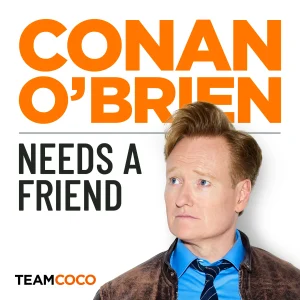
Conan O’Brien is a comic who was an early adopter of podcasting and saw the medium’s potential long before other late-night television hosts. He used his TV fan base to build a thriving audio audience for his show Conon O’Brien Needs A Friend and demonstrated how comedians could expand their brands across platforms—TV, podcasts, YouTube, and social media.
O’Brien embraced the freedoms podcasting offered: longer conversations, more sincerity, more silliness. His approach strengthened listener loyalty and helped propel the multi-platform, personality-driven strategy now common in late-night entertainment.
His digital media company, Team Coco, grew into a powerhouse of podcasts, live events, merchandise, and comedy specials. SiriusXM eventually acquired it for $150 million, with O’Brien staying on as a producer and executive.
Joe Rogan hosts one of the largest and most influential podcasts in the world, The Joe Rogan Experience. His long, unstructured interviews helped define the conversational format that dominates much of podcasting’s top tier.
Rogan’s rise was accelerated by the use of YouTube clips, which expanded his audience. In 2020, Spotify signed him to an exclusive deal reportedly worth $100 million, at the time the largest in podcasting. The agreement triggered broader industry interest in exclusive contracts and reshaped negotiations around talent, ownership, and distribution. His subsequent multiyear deal, valued at $250 million, reinforced that shift.
Rogan remains a polarizing figure. Some episodes have included vaccine misinformation, unverified political claims, and the use of racial slurs—prompting criticism from medical experts, media analysts, and civil-rights groups. Supporters describe him as an advocate for open dialogue. Regardless, his influence on podcast economics is substantial.

Connie Walker is an investigative journalist whose work centers on Indigenous stories, particularly those involving missing and murdered Indigenous women and the legacy of Canada’s residential-school system. A member of the Okanese First Nation in Saskatchewan, Walker has become a leading voice in Indigenous-centered audio reporting.
Walker’s Pulitzer Prize–winning podcast Stolen combined rigorous investigation with survivor-focused narrative, bringing national and international attention to longstanding systemic abuses. Walker’s reporting avoids sensationalism and emphasizes firsthand accounts, family histories, and community context.
She spent two decades at the Canadian Broadcasting Corporation (CBC) before joining Gimlet Media in the United States and later moving into academia as a journalism professor in Toronto. Her work has influenced both investigative podcasting and the broader inclusion of underrepresented voices in audio media.
The 44 Most Powerful Players in Podcasting in 2025 (A comprehensive look at the executives, creators, and strategists whose decisions are driving the podcasting industry in 2025).
The 75 Top Thought Leaders in Podcasting (A wide-ranging overview highlighting influential podcast strategists, creators, technologists, and advocates of the industry).
Call Her Daddy Trailer (A trailer for the two-part Hulu docuseries examining the rise of Call Her Daddy host Alex Cooper—one of the most successful and influential female podcasters—and the cultural impact of her brand and career (2025).
Age of Audio Trailer (A 2025 documentary trailer blending podcast-style storytelling with candid conversations from the medium’s pioneers, offering an intimate look into how podcasting evolved and where it is headed).
So What’s a Podcast? (A three-part 2025 docuseries that investigates podcasting’s identity crisis, its rapid evolution, and the competing visions that may shape its future).
Podcast Industry Faces Challenge After Explosive Growth (A PBS News Hour report analyzing the financial, creative, and structural challenges facing the podcast industry after a decade of rapid expansion (2024).
Ear Buds Documentary Trailer (A documentary trailer exploring the emotional and personal relationships listeners form with podcasts, featuring stories about how audio communities are built and sustained (2016).
Podcast Hall of Fame (Podcasters and those who built the medium)
Podcasting didn’t just change media—it changed how we learn.
Educators were among the earliest adopters of the medium, using podcasts to teach, highlight faculty research, strengthen institutional reputation, attract prospective students and donors, and support faculty and staff development.
These outcomes—impact on learning, visibility, community engagement, and institutional advancement—are all meaningful indicators of success. They demonstrate that the value of educational podcasts goes far beyond download numbers and lies in reaching audiences where they are, when they’re ready to listen.
This chapter highlights a selection of what is happening in the education podcast space today.
Core to the missions of higher education—podcasts help teaching and student learning.
Innovators quickly recognized the power of sound, storytelling, and connection: if podcasts could capture millions of listeners, they could also capture students’ attention—turning lessons into stories, classrooms into conversations, and learning into experiences that extend far beyond school walls.
In student learning, podcasts can be used to:
• Reinforce learning: Provide review opportunities, supplement lectures, and clarify complex concepts.
• Engage students: Allow on-demand listening, support flipped classrooms and encourage peer learning.
• Build community: Connect students with real-world experts and alumni.
• Develop research and digital literacy skills: Student-created podcasts and multimodal assignments.
Podcast assignments can supplement or even replace traditional essays, giving students a powerful format to develop communication, research, and professional skills.
For example, in my public affairs journalism course at American University in Washington, D.C., graduate students create podcasts to examine complex topics—such as disinformation—from multiple angles.
Similarly, the Washington College of Law with its commitment to social justice and public interest law, launched A Hard Look, a podcast exploring challenging questions in administrative law and regulatory policy—a project I helped them bring to life.
See the end of this chapter for a list of student podcast competitions.
Learning and teaching may define classroom life, but they’re only part of how faculty share knowledge today. Institutions large and small are turning to podcasts as a platform to showcase faculty research and expertise.
Through podcasting, scholars present cutting-edge research and participate in cross-disciplinary conversations across business, history, the arts, sciences, humanities, law, and today’s most pressing social issues. The conversational format makes complex scholarship accessible to listeners far beyond traditional academic circles.
As a result, faculty research reaches broader audiences, elevates institutional reputation, supports student and donor engagement, and occasionally transforms professors into recognizable academic podcast voices.
Just like podcasters everywhere, academics who podcast have a passion for what they do and want to share their expertise with others. Many produce shows independently, while others are fortunate to have institutional financial or staffing support.
Some of the more established scholars with podcasts include:
Andrew Huberman (The Huberman Lab) is a neuroscientist and professor at the Stanford School of Medicine. His podcast is frequently ranked in the top 10 of all podcasts, with more than 7 million YouTube subscribers.
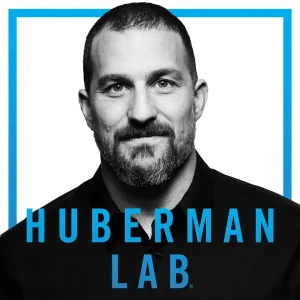
Huberman’s episodes explore science in everyday life, breaking research into understandable biology-based wellness and self-improvement lessons. His work educated and entertains a broad audience, though he has occasionally faced criticism for what some consider pseudoscience.
Matt Abrahams (Think Fast, Talk Smart) is a best-selling author and a professor of Organizational Behavior at Stanford University’s Graduate School of Business. His show has over 68 million listens and a consistent listenership of 150,000 per episode.
Abrahams focuses on enhancing communication skills —especially under pressure—to elevate professional performance. His academic work on performance anxiety and improvisational communication directly informs the exercises he shares on the podcast, translating classroom techniques into practical lessons listeners can apply immediately.
While these are two examples of highly-popular academic podcast hosts, many other scholars exert significant influence within their disciplines—even without large, mainstream audiences.
However, representation matters. Of the top 100 podcast hosts in the U.S., 77.1% are white, and women of color make up only about 7%, according to a recent report by the Annenberg Inclusion Initiative. This disparity persists even though podcast listening in the U.S. is only marginally higher among men.
The inequality in hosting highlights an important opportunity: elevating diverse academic voices who bring new perspectives and experiences to the medium.
Beyond individual scholars, colleges and universities are using podcasts for institution-branding tools—showcasing academic programs, faculty expertise, university leadership, and life-long alumni engagement.
The University of Pennsylvania’s Wharton School of Business, has expanded its brand by building a podcast network of five shows focused on major business issues.
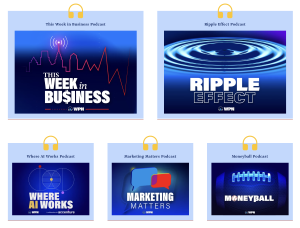
Wharton began modestly with a single flagship show, The Ripple Effect, featuring business scholars discussing emerging ideas. What started as a small experiment quickly gained traction as faculty recognized podcasting as a powerful way to highlight their research.
The school invested in a studio, provided financial support, and committed to producing a weekly program. “We had to make sure our podcasting is informational, educational, and entertaining,” says Dee Patel from the Office of University Communications. Since then, Wharton has added additional shows covering business trends, AI, marketing, and sports analytics.
American University’s Health Studies Department has launched Health Snaps, a series of brief, two-minute podcasts that break down timely public health topics. The cross-disciplinary project is produced within the College of Arts and Sciences.
Podcasts also offer a powerful way to engage community and alumni—showcasing their expertise, involving them as mentors, and illustrating the real-world impact of academic programs. These connections build alumni pride, strengthen community, attract future students, and support development goals.
This Is Purdue, is the official show from Purdue University, hosted by alum Kate Young. The podcast strengthens brand awareness and audience engagement by featuring ideas, research, and thought leadership from faculty and alumni every other Thursday. The show has won several podcast awards, ranks in Apple Podcasts’ top charts, and draws thousands of downloads.
Originally launched as an audio-only program, the podcast has since expanded into video, with YouTube as its primary outlet and short-form video clips amplifying reach on social media.
Student recruitment is the lifeblood of any college or university, and it’s occurring amid dizzying changes in private, state, and federal regulations. That makes the process increasingly complex for both institutions and the students and families they serve.
To help cut through that complexity, colleges are turning to podcasts to offer behind-the-scenes insights into financial aid, admissions, housing, and other high-stakes campus processes. These shows add a human voice to offices that can feel opaque or intimidating, and they help answer the questions applicants care about most—especially the perennial one:
“How do colleges decide who gets in and who doesn’t?”
Bucknell University, a private liberal arts college in Pennsylvania, tackles this question directly through its podcast College Admissions Insider, which is part of a broader communications strategy that also includes a blog and social media outreach.
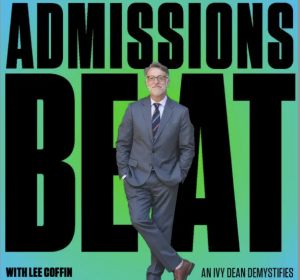
Dartmouth College in New Hampshire offers a similar public-facing resource with Admission Beat, a podcast designed for high school students, counselors, and parents. Billed as “news you can use” on the path to college, the show covers topics such as sticker shock, the evolving testing landscape, and lessons learned from families who have been through the process.
Because admissions and financial aid questions recur year after year, many university offices develop episodes around so-called “evergreen” topics—content that remains relevant long after release. Others, such as athletics or breaking-news updates, are more time-sensitive. The mix allows institutions to both respond to immediate needs and build a lasting library of guidance for future applicants.
Podcasts also play a growing role in professional development and employee morale, especially at a time when campus budgets are under stress due to declining enrollment and reduced federal and state funding.
These shows are not aimed at students but instead focus on faculty and staff, supporting teaching excellence, workplace culture, and professional development. Typical themes include teaching and learning, educational technology, organizational dynamics, and strategies to help educators adapt to change.
The EdUp Experience, one of the largest and most established higher education podcasts, talks with college and university innovators about topics such as the complexities of accreditation, college rankings, and higher education’s future. The podcast is hosted by Dr. Joe Sallustio and Elvin Freytes.
The Cult of Pedagogy Podcast is a long-running and popular show focused on educators’ professional growth, with 10+ million total downloads.
Episodes offer practical strategies—from classroom management to education reform—featuring conversations with teachers, administrators, and researchers. Host Jennifer Gonzalez also publishes articles, blog posts, and teaching resources on her website.
The Continuing Studies Podcast explores the unique world of university podcasting by sharing experiences, lessons, and advice from those behind the mic—including production teams, hosts, and campus marketing professionals.
Hosted by Neil McPhedran and Jennifer-Lee Gunson, the show covers everything from the technical aspects of audio production to the art of storytelling and interviewing, featuring campuses with strong institutional podcast support as well as institutions where podcast creators are navigating the process independently.
The Teaching Table at the University at Buffalo is a monthly podcast offering conversations to support educators with tips on teaching strategy, faculty well-being, and pedagogical issues. Hosted by learning designer Maggie Grady, the show explores practical approaches to teaching in today’s higher education environment.
Podcasts are also being used to build workplace pride, community, and satisfaction, especially during times of financial strain.
Any college or university faculty member knows that while students may be attracted to a particular program or professor, it is the broader community of staff members who make campus life function.
Central Speaks, at the University of Central Missouri, highlights the people and stories that shape the institution. Episodes feature staff and community members who reflect innovation and service on campus. The goal is to energize, engage, and reaffirm staff members’ value in the educational mission.
Instead of making all podcasts public—just like many businesses, colleges and universities can use internal podcasts to help employees stay connected, share updates without screen fatigue, support training and onboarding, and provide a space for important conversations.
While similar to public podcasts, internal podcast access is restricted to employees, keeping content private. Platforms like uStudio report that clients now produce an average of 10 internal podcasts, demonstrating the growing value of this approach.
It’s become much easier to locate and explore higher education podcasts thanks to the creation of the searchable podcast directory “HigherEd Pods,” which lists hundreds of shows.
The goal of the site is to build a community for those producing, promoting, and supporting college and university podcasts.
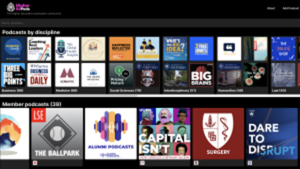
The directory was created by co-founders Neil McPhedran and Gregg Oldring.
The growth of the community of higher ed podcasters took a major step forward in 2025 with the launch of the first ‘HigherEd Pod Con,’ which brought together academic podcasters, students, strategists, and faculty, and staff to share expertise and build new connections.
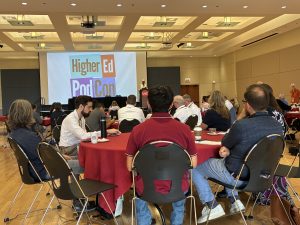
The community is continuing to expand with a two-day, in-person event planned in Cleveland, Ohio in 2026 —further evidence that institutions are recognizing the value of podcasting for teaching, research communication, and outreach, and has evolved into a dedicated convention.
The event was founded and organized by a team of higher-ed podcasting leaders: Elvin Freytes and Dr. Joe Sallustio of The EdUp Experience, Dean Hoke of Small College America and EDU Alliance Group, and Gregg Oldring and Neil McPhedran of HigherEd Pods. Oldring also created the community hub, ‘Higher Ed Pods’ directory.
As podcasting gained momentum in classrooms, a natural next step emerged: opportunities for students to share their work beyond campus. That demand helped fuel a growing ecosystem of student podcast competitions.
Student podcast competitions have rapidly become a vibrant training ground where young storytellers can test their skills, gain national recognition, and engage deeply with real-world issues through audio journalism and narrative craft.
NPR’s Student Podcast Challenge—now drawing thousands of entries nationwide —includes competitions for both middle-school and college students.
For college students, the competition runs during the fall academic season and awards a $5,000 grand-prize scholarship and $500 finalist prizes. Entries must be 3–12 minutes long, and submissions may come from individuals, teams, personal projects, or class assignments.
Topics among finalists have included climate change, gender and identity, campus politics, and mental health. Winning entries have ranged from a deeply personal narrative about a rare mental health condition to a reflective piece on happiness as a young, single person. Many entries stand out for sound-rich storytelling, strong writing, and compelling narration.
For grades 4–12, NPR’s Challenge has spotlighted stories on immigration experiences, hair discrimination, and even what happens when a high school party spirals out of control. A recent top prize went to a student whose podcast explored life with an incarcerated parent.
Beyond NPR, several other prestigious contests recognize high-quality, sound-rich work produced fully by students, helping them build portfolios, confidence, and real-world media experience.
Collectively, these competitions highlight the power of student-created audio—whether exploring identity, community issues, mental health, or personal narratives—and demonstrate how podcasting has become an essential platform for the next generation of journalists and creators.

Tools for Podcasting Copyright © by Jill Olmsted is licensed under a Creative Commons Attribution 4.0 International License, except where otherwise noted.